FAQs
James Gin is a range of award-winning craft gins created by James May and Master Distiller Hugh Anderson, distilled in Wiltshire and sold in over 30 countries. Below are answers to the questions we get asked most often – about who makes it, what's in it, where to buy it, and whether the awards are real.
About James Gin
Where is James Gin made?
James Gin is developed by James May and Master Distiller Hugh Anderson in a small distillery in the middle of nowhere in Wiltshire, roughly 20 miles from James's pub - which is, incidentally, how the whole thing started. Once the recipe is finalised, it's scaled up at Thames Distillers in London, where the Maxwell family has been distilling since 1681 (so they know a bit about what they're doing). The gin is then bottled in Hampshire. The whole process - from concept to bottle - takes place in England, where gin was invented.
What flavours does James Gin come in?
James Gin currently has five flavors:
- JG.01 Asian Parsnip - sweet, spicy, and unmistakably British. The original James Gin, inspired by the dowdy parsnip's surprising complexity.
- JG.02 Navy Strength - the same Asian Parsnip base, turned up to 57% ABV for those who feel 40% is a bit timid.
- JG.03 American Mustard - warm, smooth, and savory. Inspired by quintessential flavors of America - the hot dog and the cheeseburger - which James spent a great deal of time studying.
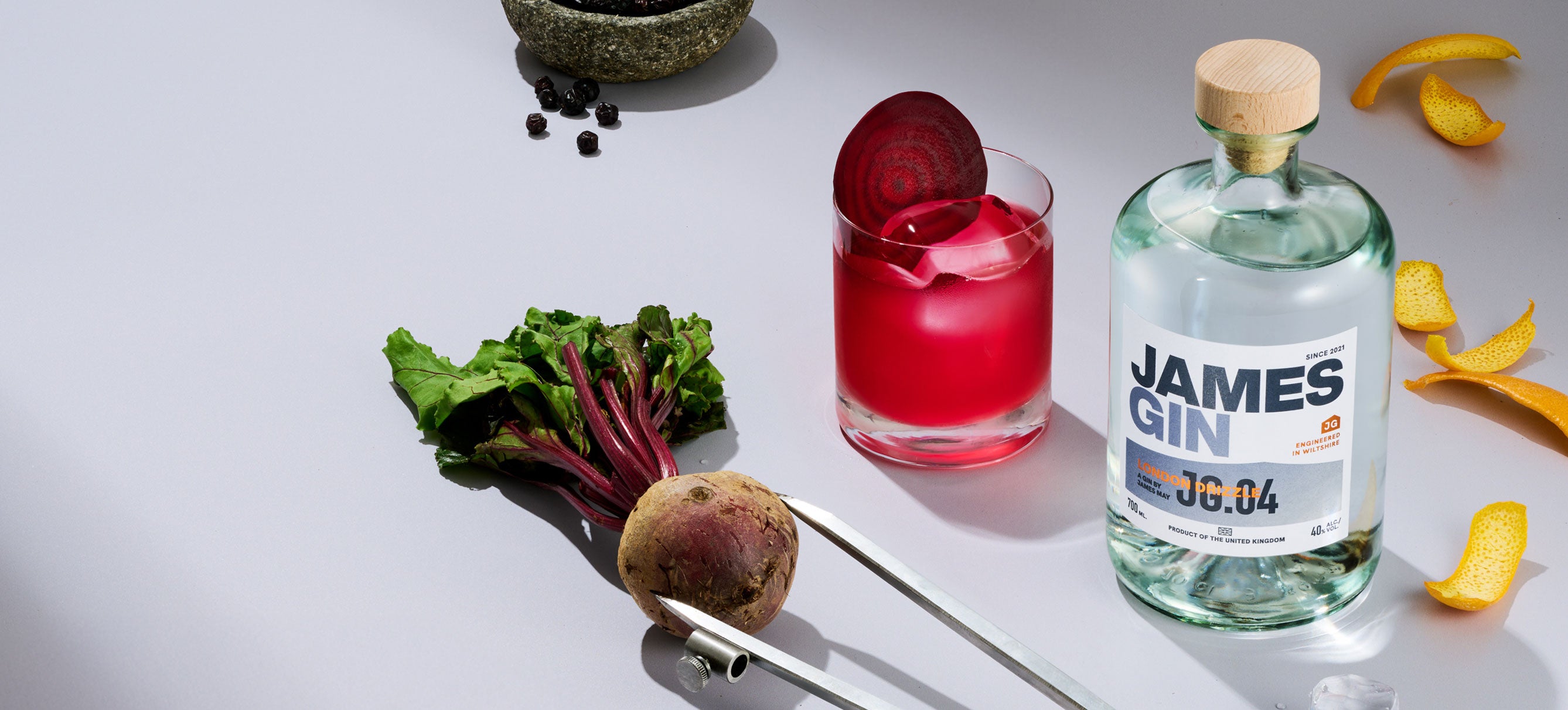
- JG.04 London Drizzle - light, earthy, and faintly melancholic, in the best possible way. Reminiscent of the aroma of rain on hot pavement. If you know London, you'll know the smell. Contains beetroot, lovage, and ginger.
- JG.05 California Dreamgin' - savory and earthy with notes of mushroom, oregano, and patchouli. Possibly the world's only gin that smells faintly of a 1970s commune, if that's your vibe, man.
Is James Gin actually made by James May?
Yes. This isn't a celebrity branding exercise where a famous face lends their name to someone else's generic liquid (like some we could mention). James May came up with every flavour concept himself - Asian Parsnip was his idea, as was American Mustard, London Drizzle and California Dreamgin'. (Asian Parsnip Navy Strength was actually a customer's idea but James is going to claim credit anyway). He works directly with Master Distiller Hugh Anderson, who develops the recipes in his freezing cold micro-distillery in rural Wiltshire. James is involved at every stage, from the initial flavour idea via 'testing' vast quantities of recipe ideas through to final recipe sign-off.
What makes James Gin different from other celebrity gins?
Most celebrity gins are created by a brand that licenses a famous face to market a pre-existing product. James Gin was created the other way round — James May had the flavor ideas first, then found a distiller to help him realize them. The result is a range of gins that are genuinely unusual and taste like nothing else on the market. Asian Parsnip, American Mustard, and California Dreamgin' in particular have no real equivalents. The gin has won multiple independent awards and has a growing, loyal customer base who buy it because they like it, not because of who made it.
What botanicals are in James Gin?
All James Gin expressions contain juniper (mandatory - without it, it isn't gin), angelica root, licorice root, coriander seed, and water. Individual flavors then have additional distinctive botanicals: Asian Parsnip and Navy Strength include parsnip, grains of paradise, and rosemary. London Drizzle adds beetroot, lovage, and ginger. California Dreamgin' includes mushroom, oregano, and patchouli leaf. American Mustard uses a blend of mustard seed and dill pickle developed to capture the essence of American mustard without tasting like a condiment.
What ABV is James Gin?
Most James Gin flavors are bottled at 40% ABV. The exception is JG.02 Navy Strength, which is bottled at 57% ABV - the traditional strength at which gunpowder would still ignite if the gin spilled on it. We don't recommend testing this (although we have, to much amusement).
What is it with some people who were once on the telly that they think they can now make a gin or cheese or a sustainable plant-based chutney and the rest of us should flock to buy it?
Thank you for your enquiry. We are experiencing an unusually high volume of enquiries at present. Why not chat to us on line? Maybe later.
Drinking James Gin
What is Gin Made From?
Gin is a distilled alcoholic beverage made from a neutral grain spirit base (usually wheat, barley, rye, or corn). Flavors are then added; for a drink to be classified as a gin, juniper berries must be added; otherwise, it is simply a ‘flavored spirit’.
To construct gin, you take a neutral ethanol base, which has all the personality of distilled water, and redistill it in a copper pot with a precise matrix of dried seeds, roots, and barks.
In our particular case, we include ingredients like parsnips, mustard seed, or beetroot, depending on how adventurous Hugh is feeling in the Wiltshire shed that day. It is straightforward thermal distillation, not alchemy.
How is Gin Made?
Gin is made by distilling neutral grain alcohol with juniper berries and botanicals in a copper vessel, condensing it back into spirit, and diluting it with water.
Ultimately, it is basic physics. Anyone who tells you it is a mystical process is either a lunatic or short on cash and trying to charge you more. Here is exactly the process:
- The Base Spirit: Start with a neutral grain spirit; essentially pure ethanol with all the personality of distilled water.
- The Copper Vessel: You pour it into a copper still. Copper is used because it reacts chemically to strip out foul sulfur compounds, not because it looks nicely retro in promotional photographs.
- Thermal Vaporization: You heat the liquid to roughly 78.4°C (which is 173.1°F, though why anyone would choose to calculate distillation vapor points in Fahrenheit is beyond comprehension). As the ethanol boils, the rising vapor strips essential oils out of the matrix; whether that’s standard juniper or, in our case, actual parsnips.
- Condensation: The vapor passes through a water-cooled pipe, condensing the gas back into a high-proof liquid spirit.
- Hydration: You add pure water to reduce the ethanol concentration to 40% ABV (or 57% for Navy Strength), push a cork into the top, and put it on a shelf.
Is Gin better than Vodka?
Gin is better than vodka because it's effectively vodka but having a party. It starts off essentially as a vodka, as a neutral grain spirit - and it is re-distilled or rectified, to use the correct technical term, with the botanicals, the things that give it the flavour, notably juniper. Vodka has no real taste and it has no character and it therefore obviously has no point other than to make you very drunk.
What is the difference between gin and vodka?
The main difference between gin and vodka is that gin is redistilled with juniper berries and botanical aromatics for flavor, whereas vodka is typically distilled and filtered to be a neutral, unflavored spirit. Some vodka companies will add flavors post-distillation.
At a foundational level, gin is just vodka that’s been given a job to do.
Both start life as the exact same neutral grain spirit, essentially high-proof ethanol and water. Vodka is then filtered repeatedly until all flavor, aroma, and personality are erased. Its sole purpose is to render fruit juice alcoholic without you noticing.
Gin takes that same neutral base and redistills it with juniper and botanicals to actually give it some character. Vodka is just gin before anyone bothered to do the interesting bit.
Feel free to look up which action star is distilling fermented Idaho potatoes. Vodka is just diluted spud water; gin actually has a point.
Should a Gin Martini be stirred or shaken?
There is no difference whatsoever between a shaken and a stirred Martini. It's performative, it's theatrical. If the line hadn't been added to a James Bond novel in 1956, nobody would even think of it. Nobody can tell. It makes no difference. Do not worry about it.
Is gin gluten-free?
Yes, pure distilled gin is gluten-free because the distillation process removes all gluten proteins from the base grain spirit, making it safe for people with celiac disease.
Slapping "Gluten-Free!" on a gin bottle is a popular marketing gimmick, but it’s a bit like advertising tap water as fat-free. During distillation, the ethanol turns into vapor and leaves the heavy gluten proteins trapped at the bottom of the boiler. Science did the work, not a wellness consultant.
What is sloe gin?
Sloe gin is a red-based liqueur made by infusing sloe berries in gin with sugar, producing a sweet spirit with a lower alcohol content of 30% ABV.
Chemically, it’s closer to an alcohol fruit syrup rather than a proper distilled spirit. If you are searching for a real gin, try ours.
What is dry gin?
London Dry Gin is a style of gin in which all the flavor goes in during distillation, and very little goes in afterward. The juniper and other botanicals are redistilled with the spirit in a traditional still. After that, the rules allow only water, a drop more of the same spirit, and a quantity of sugar so small (0.1g per liter) that it's barely worth the paperwork. No flavorings and no colorings. It must also taste mainly of juniper, which is what makes it gin rather than a very determined vodka.
It doesn't have to be made in London. "London" is the name of the method, in the same way that a Scotch egg is allowed to leave Scotland."Dry" doesn't mean it isn't wet. It is a liquid, after all. It just means it isn't sweet.
How many calories are in gin?
A standard 1.5-ounce (44 ml) serving of 40% ABV gin contains approximately 97 calories, coming entirely from the alcohol content rather than sugars, fats, or carbohydrates.
A "low-calorie" label on a bottle of pure gin is a bit like advertising a hammer as sugar-free. Distilled spirit contains zero carbohydrates, meaning the calories in your glass come entirely from the ethanol itself.
If you step up to our 57% Navy Strength, the calorie count rises simply because there is mathematically more alcohol in the vessel. Gin is a beverage for pleasure, not a workout supplement. And if you proceed to drown it in two hundred milliliters of sugary tonic water, worrying about the caloric density of the spirit becomes entirely academic.
Is James Gin a 'Boutique Gin'?
'Boutique gin' is a way of saying this gin is made in very, very small volumes because not very many people like it and not very many people buy it. This does not apply to James Gin.
What is the best glassware in which to serve gin?
Cylindrical is a good basic attribute of glassware for drinking gin and sealed off at the bottom, but open at the top.
What are the best gin and cheese pairings?
There are no gin and cheese pairings. Gin doesn't pair with things. It's a drink to be enjoyed in its own right, as a cocktail, as a gin and tonic, or neat if you're a gin aficionado. Saying gin and cheese pairings is a bit like saying cheese and Alfa Romeo pairings. It doesn't make sense. Although, having said that, the Spider would go quite well with a bit of Manchego.
Why did you make your gin look like a bottle of medicine?
Because it is.
Can I refill my empty James Gin bottles with Ryan Reynolds' Aviation gin? I've got loads of that stuff kicking around, but I don't want my mates to know.
We cannot recommend this. Aviation Gin, pretending to be American, is imperial and will not fit in the modern metric James Gin bottles without coming loose and potentially causing injury or death.
Does gin go bad?
Technically, no. High-proof alcohol is completely sterile, so an unopened bottle will easily outlive you. Once opened, oxidation slowly degrades the botanical oils. It won't make you sick, but leaving a good gin sitting half-empty for two years just turns a carefully distilled spirit into a slightly tired one. Put the stopper back in properly, store it somewhere cool, and drink it. It's not complicated.
Awards & Recognition
Has James Gin won any awards?
Yes. James Gin has won multiple awards from independent spirits competitions. These include gold medals at the San Francisco World Spirits Competition and the World Gin Awards, where James Gin has won three Country Winner titles. For a full list, see our Awards page.
Buying James Gin
Is James Gin available in the UK?
Yes. You can buy James Gin directly from this website with free UK shipping on orders over £50. James Gin is also stocked by a growing number of retailers, pubs, and restaurants across the UK. Use the Find a Stockist page to locate your nearest stockist.
Is James Gin available in the United States?
Yes. You can buy James Gin directly from our US website (https://us.jamesgin.com). James Gin is also available in Total Wine & More stores across the United States - one of America's largest specialist drinks retailers with over 240 stores nationwide and a growing number of other retailers and bars across the US. Use the Find a Stockist page on the US website to locate your nearest stockist.
Is James Gin available in Australia?
Yes. You can buy James Gin directly from our Australian website (https://www.jamesgin.com.au) where James Gin is distilled, bottled and distributed under license by Wildflower Gin Distilling Pty Ltd.
Is James Gin available in other countries?
Yes. You can buy James Gin directly from our global website (https://global.jamesgin.com). We currently sell to over 30 countries including most of Europe, Singapore, Hong Kong, Japan, South Africa, South Korea and Sweden. Even Monaco, should you need supplies for your super yacht Jeff. Select your country at checkout to see shipping options and costs.
Does James Gin do gift sets?
Yes. We offer gift sets and gift packaging options, which are particularly popular around Christmas and as birthday gifts for gin drinkers, Top Gear fans, and people who are generally difficult to buy for.
the Company
How did James Gin start?
James May bought a half-share in his local pub to stop it from closing. Needing something interesting to put behind the bar, he came up with the idea of making his own gin. Working with Master Distiller Hugh Anderson in Wiltshire, he developed the Asian Parsnip recipe, made a test batch, put them online, and sold out in 36 hours. The rest, as they say, is gin history.
When was James Gin founded?
James Gin was founded in 2021. The first flavour, Asian Parsnip, was initially made in a batch of 1000 litres intended for James May's pub before being sold online - where it sold out within 36 hours.
Who owns James Gin?
James Gin is a brand of Asian Parsnip Ltd, a company co-founded by James May and his business partners. Asian Parsnip Ltd is a UK-registered company (Company No. 13370389, VAT No. GB 384393758), based in Bristol.
Where is James Gin made?
James Gin is developed by James May and Master Distiller Hugh Anderson in a small distillery in the middle of nowhere in Wiltshire, roughly 20 miles from James's pub - which is, incidentally, how the whole thing started. Once the recipe is finalised, it's scaled up at Thames Distillers in London, where the Maxwell family has been distilling since 1681 (so they know a bit about what they're doing). The gin is then bottled in Hampshire. The whole process - from concept to bottle - takes place in England, where gin was invented.